
Part 1 of 3
Stories From Another Era By Margaret G. Hanna
My paternal grandmother, Addie Hanna, told me that she burst into tears when she saw the homestead shack.

So would you, if you had grown up in a “proper” house just outside a prosperous town in southern Ontario. If you had traveled three days by train from Toronto to Winnipeg (where you married your fiancé) and then another day by train to Moose Jaw. If you had just spent 3-1/2 days bouncing across a roadless prairie in a horse-drawn wagon containing all your worldly possessions. If you had got up at the crack of dawn on the last day to jolt the last several hours to the homestead. If you were tired and cranky, and if every bone in your body ached.
And then, THIS! A shack on the bald-ass prairie, not another house and certainly no town anywhere in sight.
This photograph was taken July 15, 1910, the day Addie arrived at the homestead. She told me they had to pay a whole dollar for the photograph, leaving them with only $6.00 for the winter.
She may have cried initially, but Addie was one tough lady. She climbed down off the wagon, took one look at the inside of the shack, and promptly told Abe to make it more habitable. After all, this is the woman who, many years later, proudly proclaimed that, “unlike some other women,” she stayed on the homestead during the winter when Abe was away hauling coal or supplies.
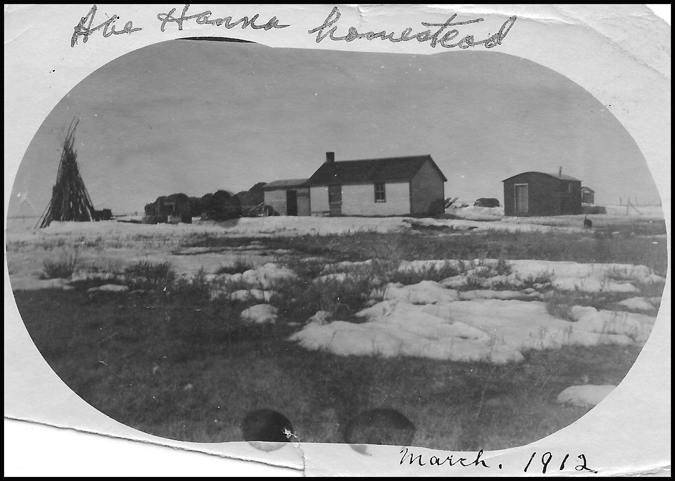
So why are there two “houses” in this picture?
Therein lies a tale of an ambitious young man.
Abe Hanna, my grandfather, had come to Saskatchewan from Ontario in early 1908 to work on a great-uncle’s farm just north of Moose Jaw. In December of 1908, he filed for a homestead quarter – 160 acres – about 100 miles (as the crow flies) southwest of Moose Jaw. In January, 1909, he took up residence (in a tent!) on the NE quarter of Section 25, Township 8, Range 7, West of the 3rd Meridian.
By June of that year, Abe had built a 12’ x 14’ one-room shack (the one that Addie cried over). He had also purchased a Volunteer Bounty Land Grant scrip from a Boer War veteran, whereby he obtained the adjoining south half of the section.
“Proving up” a homestead was a three-year process. Each year, Abe had to break a minimum of 30 acres and reside on the homestead (the NE quarter) for a minimum of six months. But the scrip land (the south half) had exactly the same requirements: each year, break a minimum of 30 acres and reside on it for a minimum of 6 months.
Abe chose his homestead house site wisely, a stone’s-throw north of the boundary between the NE quarter and the S half. Then, just across the boundary, on the S half, he built a bigger house – 14’ x 24’ with two rooms!
Abe and Addie lived in the homestead shack from April to October, then, come November, they moved south across the border to live in the scrip house until March. I, therefore, maintain that my grandparents were the first “snowbirds.”
They moved from one house to the other for three years until both the homestead quarter and the scrip land were proved up. Once Abe had the official papers in hand that he had fulfilled all the requirements and now owned the land, they moved permanently into the scrip house. The homestead house became a granary.
Next time: A new farmstead location and a new house.
Addie tells all about arriving in “The West,” the trip to the homestead, and her reaction to the homestead shack in “Our Bull’s Loose in Town!” Tales from the Homestead.

Margaret G. Hanna grew up on the farm her paternal grandfather homesteaded in 1908 in southwestern Saskatchewan. After 12 years of university, she worked as a professional archaeologist, first on several short-term contracts in Saskatchewan, Manitoba and Alberta, and finally as Curator of Aboriginal History at the Royal Saskatchewan Museum, Regina. She retired in 2007 and moved to Airdrie AB where she lives with her husband and no pets.
She now uses her research skills to explore family and prairie history. For Margaret, writing is a portal to another dimension of reality. When she isn’t struggling to write, she gardens, reads, sews, and quilts. Her dream is one day to master the 5-string banjo, claw-hammer style.
Margaret’s books can be found through her website, A Prairie Perspective, and on Amazon.
 Blog
Blog 