
Part 2 of 3
Stories From Another Era By Margaret G. Hanna
By 1917, the Hanna family had expanded – Edith was born in 1911 and Bert in 1915. Two small children may not be physically big but psychologically they take up a lot of space. Many times that two-room scrip house must have seemed too tiny to house two growing, and rambunctious, children.
The village of Meyronne was also growing. It was no longer a hodge-podge of buildings scattered across the prairie; it was now a regular townsite (situated partly on the southwest corner of Abe’s farm, thanks to the Canadian Pacific Railway that had arrived in 1913 – see Note 1) with homes and businesses fronting several streets. Meyronne also boasted slightly more than 100 inhabitants, with enough pupils to justify building a new, two-room brick school house at the north end of the village.
I don’t know when or how Abe and Addie decided to build a new house, but Addie, being the strong-minded woman she was, probably had a voice in the decision. Imagine the discussions, perhaps even arguments, that Abe and Addie might have had over the years. “This house is too small for four people. I can’t turn around without bumping into something or someone!” “We can’t afford to build a new house, the crop’s poor this year.” “How about this year? We had a bumper crop. You said so yourself.” “I have to buy a new seeder, the old one’s beyond fixing.” “Why is it the farm comes first? I don’t even have a proper pantry to work in!” “Wheat prices are down, we’ll have to wait.” And so on.
However it happened, in early 1917, Abe decided to move the entire farmstead clear across the section to the west side where it would be only a quarter-mile north of Meyronne. But why move a mile across the section? Why not build a larger house on the homestead site? Two factors were probably the cause.
First, according to my father, the well on the homestead site did not have good drinking water, but there was good well water on the west side at the proposed farmstead site. That meant no more hauling drinking water from a neighbour’s well.
Second, Edith would start school in the autumn. By moving to the west side, she would have to walk only a quarter-mile on the road instead of more than a mile across the section (remember, there were no school busses in those days – students either walked or rode horses).
Moving the homestead involved more than building a new house. It also re quired building a new barn and moving the granaries and other outbuildings. Quite an undertaking when everything was done by hand-power and horsepower.
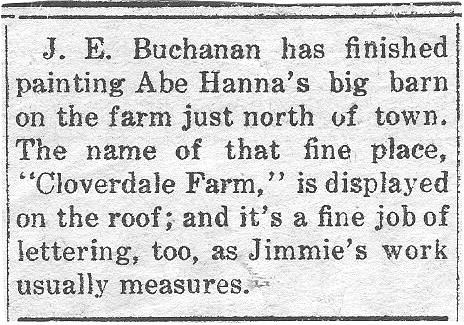
On Tuesday, June 27, 1917, Abe wrote in his diary, “Commenced digging new cellar in p.m.” On July 26, they started preparing the foundation for the new barn. Monday, August 6, Mr. Leadley and Mr. Hisey (the village carpenters) began building the barn. Abe kept busy hauling rock for the concrete. The only hitch in the barn construction occurred when Mr. Leadley fell off the barn roof and was seriously injured. When it was finished, Abe paid Mr. Buchanan to paint “Cloverdale Farm” on the barn roof.

Construction on the house began on October 1, after harvest was done. While Mr. Leadley and Mr. Hisey worked on the house, Abe hauled and sorted lumber, or bought supplies such as horse hair for the plaster, or cleaned up the construction debris. Addie was busy feeding everyone and keeping Edith and Bert both safe and out of mischief. It must have been a hectic time, but also a joyous one as the farmstead slowly revealed itself.
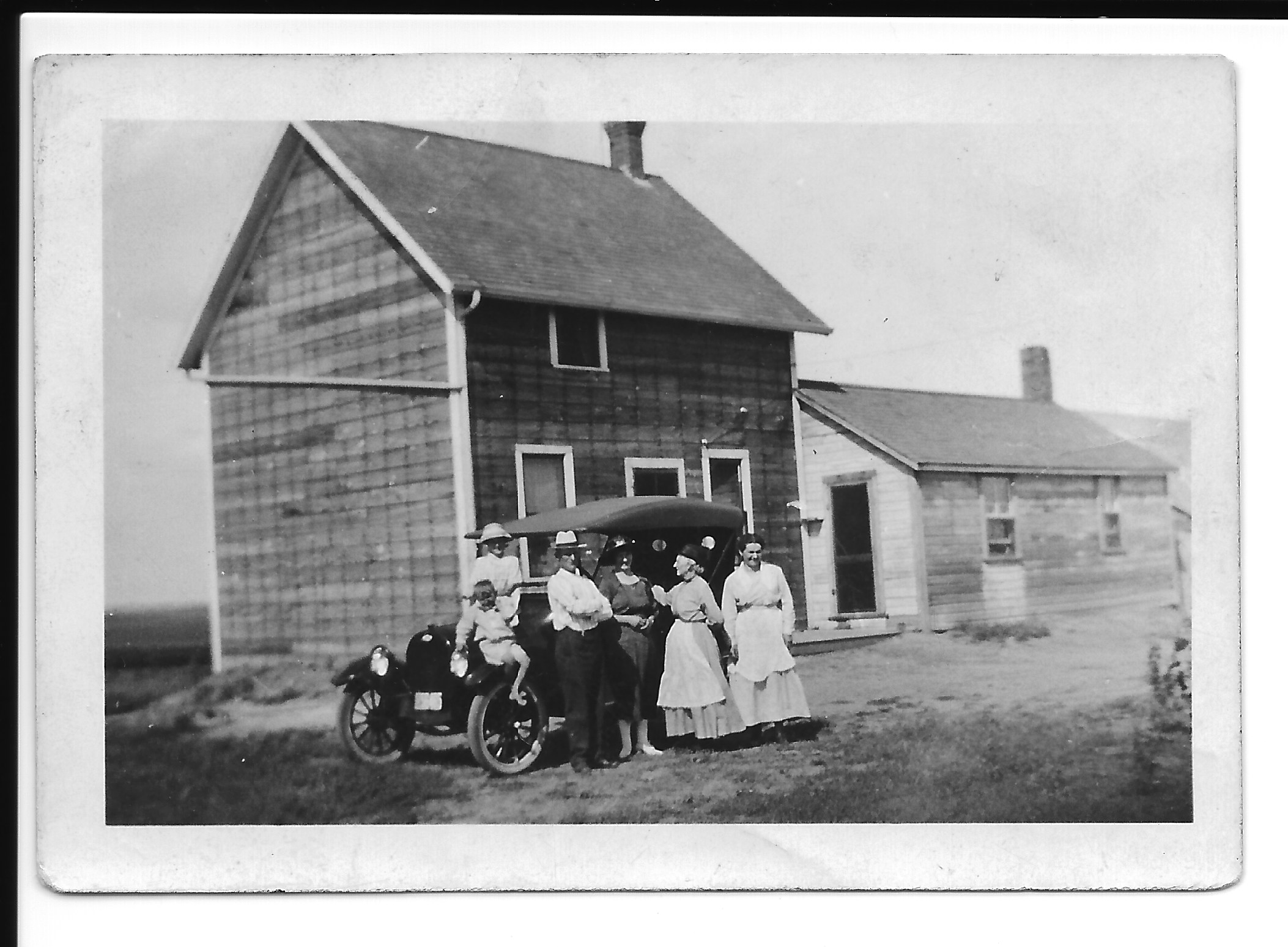
The new house consisted of two storeys. The ground floor contained a big kitchen for the cook stove, table and chairs; a wash room with an enamel sink, a hand pump and the hand-cranked milk separator; and a pantry with cupboards for dishes and everything else that Addie might need. The upstairs contained two bedrooms and a linen closet. The house also had all the modern 1917-era conveniences. A Delco power plant in the basement provided 12-volt electricity which meant electric lights and an outlet for the new and much-beloved Delco washing machine. A dumb waiter connected the kitchen to the basement. A huge concrete cistern that took up a third of the basement held rainwater from the roof via eavestrough and downspout.
Back at the homestead, whatever outbuildings could be moved to the new farmstead, were. The old scrip house (see Note 2) was butted up against the new house to provide a bedroom for the hired man. Buildings that couldn’t be moved, such as the sod barn, were torn down. Raspberry bushes, lilac bushes, and rhubarb were dug up and replanted.
Abe, Addie, Edith and Bert moved in to their new house on December 24. Abe wrote in his diary, “Set up table and chairs, A. Robinson assisted. Moved beds and dresser upstairs.” Finally, there was plenty of room for two rambunctious children. Addie said the new house was the best Christmas present she ever received.
Next time: The house expands.
Notes:
1. The CPR decided the location of each townsite along the new rail line, and Meyronne’s townsite happened to fall at the intersection of four sections (just like Four Corners in the United States). The CPR bought land from the respective landowners, which in Abe’s case was 40 acres in the southwest corner of his section.
2. The “scrip” house was the two-room house built on the south half of the section, the land that Abe had acquired in 1910 with a Volunteer Bounty Land Grant scrip.
Addie tells all about arriving in “The West,” the trip to the homestead, and her reaction to the homestead shack in “Our Bull’s Loose in Town!” Tales from the Homestead.

Margaret G. Hanna grew up on the farm her paternal grandfather homesteaded in 1908 in southwestern Saskatchewan. After 12 years of university, she worked as a professional archaeologist, first on several short-term contracts in Saskatchewan, Manitoba and Alberta, and finally as Curator of Aboriginal History at the Royal Saskatchewan Museum, Regina. She retired in 2007 and moved to Airdrie AB where she lives with her husband and no pets.
She now uses her research skills to explore family and prairie history. For Margaret, writing is a portal to another dimension of reality. When she isn’t struggling to write, she gardens, reads, sews, and quilts. Her dream is one day to master the 5-string banjo, claw-hammer style.
Margaret’s books can be found through her website, A Prairie Perspective, and on Amazon.
 Blog
Blog 