
Part 3 of 3
Stories From Another Era By Margaret G. Hanna
The Roaring Twenties were boom times, not only for Canada and for Saskatchewan, but also for the Meyronne district.
Meyronne itself was larger – the population now was close to 300 people.
The Hanna farm was larger – Abe had purchased an adjacent 320 acres.
The Hanna family was also larger—Garnet (my father) was born in 1923.
However, the Hanna house was not any larger. That was about to change.
By 1925, Abe had money in the bank. Crop yields had been good during the post-war era and so had wheat prices. Time to call on Mr. Hisey to discuss the plans for the Dream Home.
The plans were extensive. The addition added the obvious rooms – a parlour and a huge dining room downstairs, and four bedrooms upstairs – but also included plumbing that would supply hot and cold running water and drain waste water into a cesspool, and a furnace that would heat the entire house.
As I’ve written, Abe was definitely an ambitious man. The Dream House reflected that – it would be the largest house in the district.
On Friday, September 25, 1925, they began digging the cellar. Mr. Hisey ordered all the lumber. Mr. Enticknap was in charge of the furnace and plumbing. Abe and Bert (now 10 years old) were in charge of the cesspool and hauling whatever was needed for the construction of the house, be it rocks and gravel for the foundation walls, or lumber and shingles for the house. And Addie was in charge of keeping 2-year-old Garnet out of harm’s way.
The house rose up throughout November. The concrete for the cellar walls – it took 38 sacks of cement – was poured on November 2. Once it was cured, the floor and walls were framed in. The furnace, chimney and the ductwork were installed at the end of November. The house was plumbed in early December. The interior walls were plastered. Abe cut a doorway between the existing kitchen and the new dining room. The house was at least habitable, if still unfinished.

On December 30, work ground to a halt when Abe decided he had to go back to Ontario to spend time with his family (he doesn’t say why in his diary). He returned to Meyronne on Saturday, January 30. He notes in his diary, “Addie & children met me at the station.” I bet they did!
Work continued on the inside of the house all throughout January, February and March – installing woodwork around the doors and windows; painting the walls; laying oak flooring in the parlour and linoleum in the dining room and the upstairs bedrooms; transforming the little bedroom in the original part of the house into a bathroom complete with claw-footed cast-iron bathtub; and scraping and varnishing the upstairs floors and all the woodwork (the house must have reeked of varnish).
Amongst all the diary entries, a few stand out:
Saturday, March 13: Had kitchen boiler installed in am. Had fresh water tank and bath completed in pm. All had bath in new tub in evening. (What an event that must have been – just pull the plug and watch the water drain away! I bet Addie was particularly joyful – no more carting buckets of dirty water outside, no more mopping up spilled water.)
Monday, March 15: Gus Bolstad put up light fixtures in eve. (Just flick a switch and instant light, assuming the wet cells are fully charged.)
Tuesday, March 16: Addie & I went to town for new bed and linoleum in pm. Slept in new part of house overnight. (Bet that was a night to remember.)
Saturday, March 20: Bert & I went to town for dining room suite in early am. N. Hisey put lock on kitchen door. Had dinner & supper in new dining room. (That dining room suite is still in the family.)
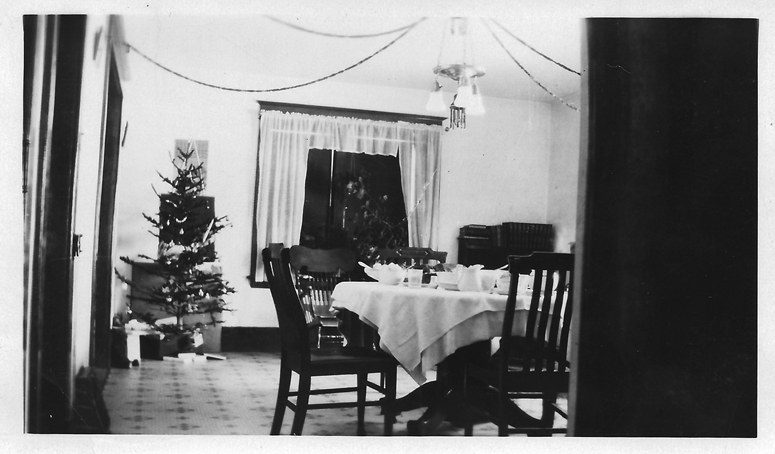
In April, the scrip house was removed from the kitchen wing and became the shop. A back porch was built where the scrip house once stood, and a sun room was built on the south side of the house. A coat of gleaming white stucco was the finishing touch. The house was finally done.

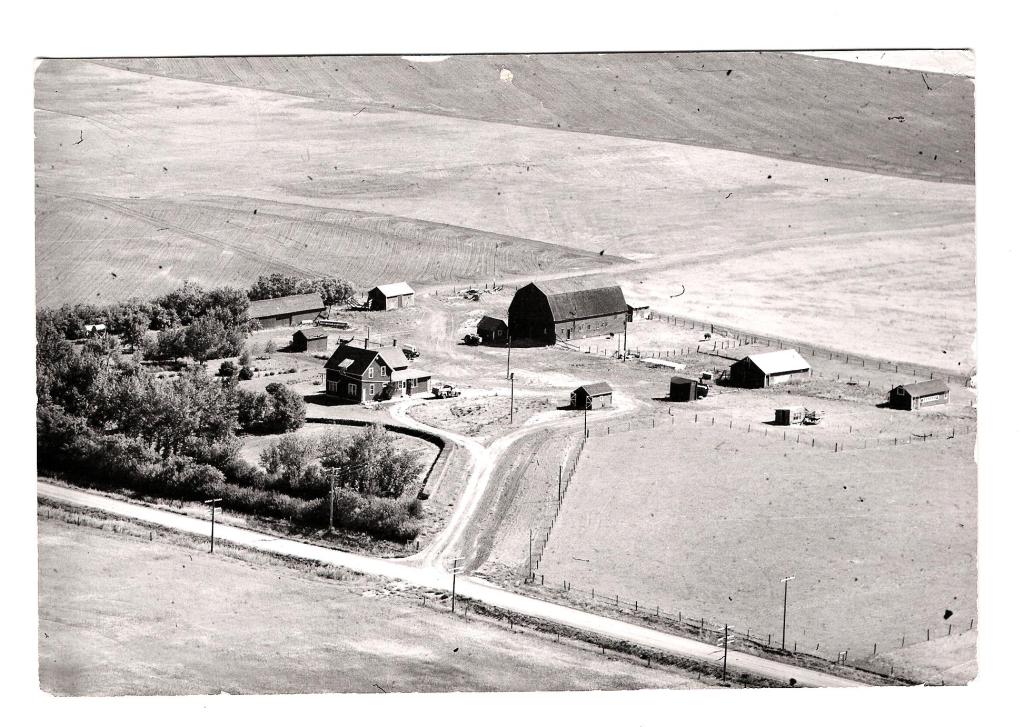
That is the house my father inherited when Abe died, that Grandma Hanna moved out of and my mother moved into when Mom and Dad married, that my brother and I grew up in, where we played and fought, partied and laughed and cried, and created a host of memories. It’s the house I returned to for rest and solace during all my working years. It wasn’t just a house, it was Home.
The house no longer stands on that little knoll north of the village of Meyronne. It was moved to just east of Swift Current, SK, a few years after Mom sold the farm. Unlike many abandoned farm houses, it is not falling into wrack and ruin. I take solace in knowing that someone now lives in it and cares for it. It was built on hope and love and commitment, and thus it should remain.

Margaret G. Hanna grew up on the farm her paternal grandfather homesteaded in 1908 in southwestern Saskatchewan. After 12 years of university, she worked as a professional archaeologist, first on several short-term contracts in Saskatchewan, Manitoba and Alberta, and finally as Curator of Aboriginal History at the Royal Saskatchewan Museum, Regina. She retired in 2007 and moved to Airdrie AB where she lives with her husband and no pets.
She now uses her research skills to explore family and prairie history. For Margaret, writing is a portal to another dimension of reality. When she isn’t struggling to write, she gardens, reads, sews, and quilts. Her dream is one day to master the 5-string banjo, claw-hammer style.
Margaret’s books can be found through her website, A Prairie Perspective, and on Amazon.
 Blog
Blog 