
Stories From Another Era By Margaret G. Hanna
How do you keep meat from spoiling when you have no electricity and, hence, no freezer? Homesteaders such as my paternal grandparents, Abe and Addie Hanna, faced that problem especially in the summer. Keeping meat frozen wasn’t as much of a problem during the winter when temperatures were (usually) below freezing. However, homesteaders quickly learned not to depend on Mother Nature to maintain the deep freeze during winter months.
But what to do during summer?
One solution was to form a beef ring of three or four farm families. Every few months, one family would butcher a steer and divide the meat with the other families. But even a quarter of a dressed steer weighs out at about 60 pounds of meat, still leaving you with the problem of keeping it from rotting during summer heat.
My grandfather’s diary provided the answer:
Monday, March 20, 1911: Salted meat
Thursday, April 23, 1914: Salted beef
Wednesday, July 22, 1914: Cut and salted meat
Okay, they salted the meat, but that raised another question: how does one salt beef?
If someone were to ask that of my grandparents, they might have replied, “You need a recipe?” Then, they would shake their heads, roll their eyes and mutter something about the ignorance of the younger generation and how the world is definitely going to hell in a handbag. Probably, everyone of that era knew how to salt meat – salt had been used as a preservative for generations.
In our generation, not so much.
Enter The Cook Not Mad; or Rational Cookery, a 1972 reprint of a cookbook originally published in 1831. As the introductory notes say, “the reader will note that by present-day standards the instructions are very sketchy indeed.” However, they were far from “sketchy” for how to preserve beef. The fact that the recipes for salting both beef and pork are at the beginning of the cookbook indicates how important that knowledge was in the era before electricity.
Recipe No. 3: To pickle one hundred pounds of Beef to keep a year:
Put together three quarts salt, six ounces salt petre, one and a half pints of molasses, and water sufficient to cover your meat after laid into the barrel. Sprinkle the bottom of the barrel with salt, and also slightly sprinkle between the layers of meat as you pack, when done, pour on your pickle and lay on a stone or board to keep the whole down. Beef salted after this method during the fall or winter may be kept nice and tender through the summer by taking it up about the first of May, scald and skim the brine, add three quarts of salt, when cold pour back upon the beef.
Recipe No. 4: To salt Pork:
Sprinkle salt in the bottom of the barrel, and take care to sprinkle the same plentifully between each layer afterwards. Let the layers be packed very snug by having the pieces cut of about equal width, say five or six inches, and placed edgewise, the rind being towards the barrel. Pork will only take a proper quantity of salt, be there ever so much in the barrel. The surplus answers for another time.
The Cook Not Mad does not provide instructions for cooking salted meat. Do you scrape off the salt? Wash off the “pickle” before cooking? How would the meat look? And taste? As stated in the Introductory Notes, “We cannot give … whole-hearted endorsement, however, to the flavour of the food resulting from these receipts.” However it looked or tasted, at least it wasn’t rotten.
Aren’t you glad we have freezers today?
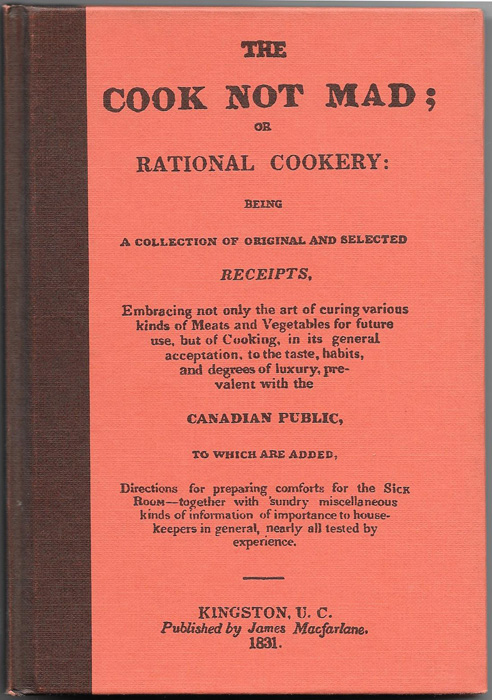
Reference: Roy A. Abrahamson, 1972 (reprint), The Cook Not Mad; or Rational Cookery: being a collection of original and selected receipts … (originally published, 1831, James Macfarlane, Kingston, U.C.)
p.s. “U.C.” means “Upper Canada,” now Ontario.

Margaret G. Hanna grew up on the farm her paternal grandfather homesteaded in 1908 in southwestern Saskatchewan. After 12 years of university, she worked as a professional archaeologist, first on several short-term contracts in Saskatchewan, Manitoba and Alberta, and finally as Curator of Aboriginal History at the Royal Saskatchewan Museum, Regina. She retired in 2007 and moved to Airdrie AB where she lives with her husband and no pets.
She now uses her research skills to explore family and prairie history. For Margaret, writing is a portal to another dimension of reality. When she isn’t struggling to write, she gardens, reads, sews, and quilts. Her dream is one day to master the 5-string banjo, claw-hammer style.
Margaret’s books can be found through her website, A Prairie Perspective, and on Amazon.
 Blog
Blog 
Wow, how interesting. Thank you for sharing the recipe and practice for salting meat!
LikeLiked by 1 person
Wow, how interesting. Thank you for sharing the recipe and practice for salting meat!
LikeLiked by 1 person