

By Janelle Molony & David Grassé
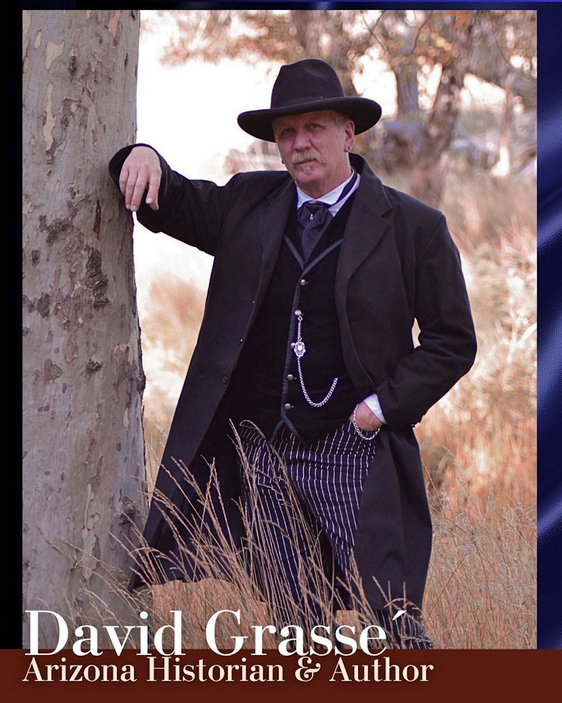
Arizona native and WWW member Janelle Molony is proud to introduce David Grassé to the field of female-centric writers as a positive example of someone casting aside the gratuitous and cheap trope analysis that is often used as the lens writers look through when approaching the subject of sex workers of the past.
Grassé approaches this topic in a tasteful and critical manner, unshielded by religious perspectives or modern-day political agendas. Rather than speaking for or above the women of the demimonde, he comes alongside them and explores the cultural, legal, and political situations they navigated. In his writing, he forces the reader to consider the practical implications of a lifestyle often looked upon with shame, highlighted for lusty effect, or pitied in an attempt at heroic redemption.
At the 2026 Women Writing the West Conference, Grassé will share his experience researching women of the demimonde (French for the half-world; popular Western literature calls these women “Shady Ladies”) and ways he has ensured his work received proper checks and balances when nearly all the literature and empirical evidence was slanted.
He will describe ways he’s helped fill in some gaps in women’s lives in a way that does not assume the stereotypical. And he will relate how he has handled the “missing” women who—for whatever reason—leave no trace of their identify outside one chance photo with their preferred name.
An example of such a woman he’s studied, and the challenge of telling her story, is Ms. Elena Estrada. She was a Hispanic prostitute who worked in Tucson’s restricted district, commonly known as Gay Alley. Material about her is relatively scant. It’s not enough to craft a cozy tale, yet it’s more than what most women in the profession leave behind. Elena’s story is that of Starlight Thorn.
Meet Elena (Tucson, Arizona Territory)
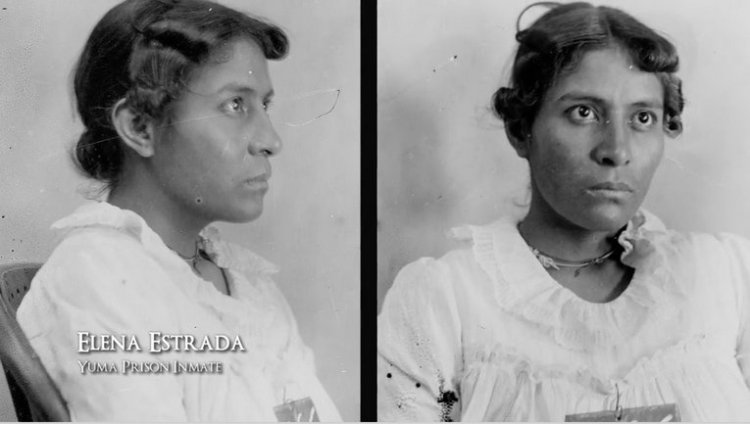
Tucson’s constables considered Elena to be “a troublesome character.” On March 5, 1899, she and a colleague, Santas Corallias, appeared in court under charge of stealing $9.50 from a customer. The women were found guilty and sentenced to pay a $16 fine or sit in jail for sixteen days. They chose the latter. Elena was arrested again on October 15th and again on the 27th. The charges: being drunk and disorderly. She was fined $7.00 both times. For context, that is about the equivalent of $280 in 2026, when a current D&D fine runs as high as $2,500, plus jailtime and probation.
In January of the new year, Elena was arrested for another D&D. These criminal events were mere pepperings in the newspapers and easily overlooked mentions in the court docket, but they are enough to establish a pattern of behaviors that can afford a writer a framework for character development.
Elena’s Habits Invited Serious Trouble.
In 1900, amid the lengthy evening celebrations for Independence Day, Elena became a murderess, drawing the red from a white-faced man, whose family would soon be blue.
Testimony given at her preliminary examination indicated Elena was drinking in Gay Alley with her friends, Isabella Rodriguez and Angelita Jacquez. A young man, identified as Refugio Bindiola, followed the women around and verbally harassed Elena.
(Janelle: Reflecting on this as a modern-day woman, it is right at this point in the story that I have already connected to the fearful and decidedly deadly plan that can enter a woman’s mind. And little to no storytelling “fluff” was necessary.)
The women tried to lose their stalker by sneaking off to a vacant lot while he was using a water closet, but he quickly found them and closed the distance. Angelita and Isabella observed Refugio attempting some late-night and unwanted horseplay with their friend. In an instant, the fun and games ended when Elena drew a knife and stabbed the man who had gotten too close. Elena’s friends defended her with an explanation that she was quite drunk and probably not meaning to harm someone.
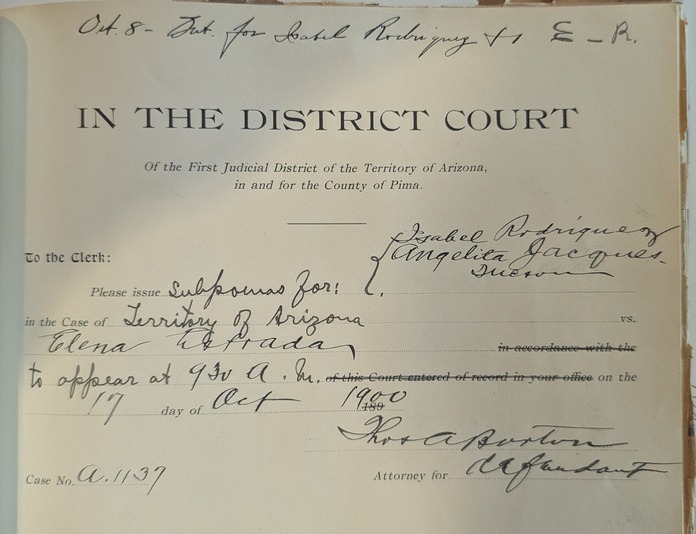
Witnesses stated they saw no blood on the street. Angelita took Elena back to her rooms, where she passed out. Refugio’s friends eventually came around, found him wounded out on the street, then took him home. He died from the wound. Elena was arrested and charged with first degree murder. After being indicted by a grand jury in October, Elena plead guilty to the lesser crime of manslaughter.
(Janelle: There is no need to insert any mention of or attempt an emotional appeal for modern-day considerations of consent or self-defense as viable options. These weren’t afforded her then, so there is no need to enhance the narrative to please a woke crowd. Let the woman fight her own battle.)
Finally, We Can “See” the Starlight Thorn.
Elena was sentenced to seven years in the territorial prison as inmate #1685. Unfortunately, it is there where the best records on her person are found. It is also where a photograph was taken.
According to the dossier (criminal log), Elena was twenty-five-years old, five-feet-one-inch tall, weighed 129 pounds, and was a native of Mexico. It was remarked that she had “good teeth.” Elena claimed she was temperate (i.e. sober, but obviously, she was not), she had used tobacco but abstained from opium.
She was Catholic, not married, had no children, and her nearest living relative was Juana Martinez of Hermosillo, Sonora, Mexico. She noted that she was educated in a public school in Mexico, and could read and write. She had $1.15 in her possession when she was inducted (about $45 today). From here, a trained genealogist has material to run with.
Elena was paroled by Acting Governor William Francis Nichols on November 26th, 1904, and released on Christmas Day. What became of her thence, is currently unknown.
Could A Woman Like Elena Be Your Next Writing Muse?
If it weren’t for her criminal case, Elena might never have been identifiable. Further, if the woman belonged to the upper strata in this profession, such as an affluent man’s concubine or the inmate of an upscale parlor house with police protection, there might have been fewer records in existence.
Also, as demonstrated here, even with what little can be obtained, a gripping and relatable tale can be told. Perhaps it is not enough for a full-length nonfiction work, but could the Starlight Thorn be the basis for a lead in your next novella, or for a company role in your next screenplay? We think so.
Writing on History’s Sex Workers: A Feminist Approach
Janelle Molony & David Grassé
2:15 PM – 3:15 PM Saturday Oct 17
2026 Annual Women Writing the West Conference registration portal

…has recently released Red Light Districts of Tucson (2026), a comprehensive study of Tucson’s historical sex-working industry, the politics and the players.

…aka the “Hottie Historian” on YouTube, writes on Women, Wars, and the West. Her latest, Birds Gone Wild (And Other Stories of Arizona Ostrich Ranching) encompasses all three.
Thanks for reading! Scroll down to join the discussion.

