By Suzanne Stauffer
Last time, I mentioned City Business Directories, and promised to provide information about more reference resources that you can use to give authenticity to your work.
These are not for historical fiction authors only. Authors of history and memoirs need historical information, but authors of contemporary fiction often need historical background to create authentic settings. Writers of supernatural stories may want to incorporate genuine legends and folklore; how much more compelling is a ghost story if the ghost was a real person?
Geographic Resources
Let’s start with reference resources that help us create authentic physical settings.
Atlases
Atlases are simply books of maps. They give you a visual picture of a place, rather than a written description. They include geological maps, with rivers, mountains, forests, etc., indicated; maps of countries, states, cities and regions. Navigation maps. Thematic maps of agriculture, geology, climate, history, industry, languages, population, religions, resources, or other characteristics of a geographic area.
Gazetteers
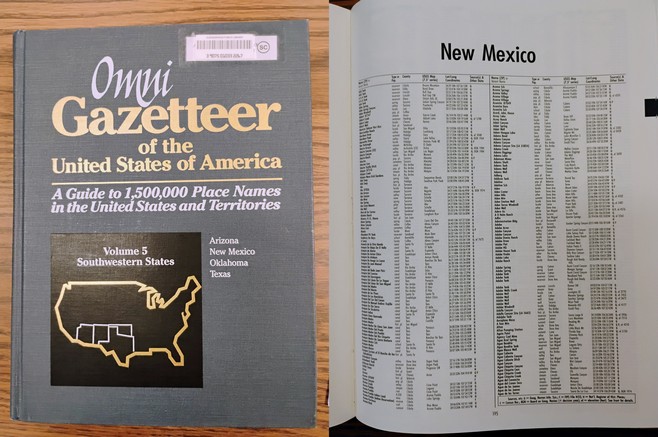
My personal favorite, if only because the name is so much fun to say, gazetteers are dictionaries of places, arranged alphabetically by name or hierarchically by place. They include cities and towns, as well geographic features. Each entry provides information about the location. Some gazetteers include thematic indexes, so that you can identify places with specific characteristics.
Let’s look at the volume for New Mexico. Here’s the first page:
Note that it includes geographic features, as well as places. The columns indicate the type of feature, the county in which it is located, the location on the USGS map (which the library also has; just ask at reference), the latitude & longitude, the source of information (the key is at the bottom) and occasionally other data. If you’re looking for a handy body of water to dump that body, you can find it in just a few minutes.
There are also gazetteers by topic. The one I use most often is the historical gazetteer. Again, let’s look at a page for New Mexico:
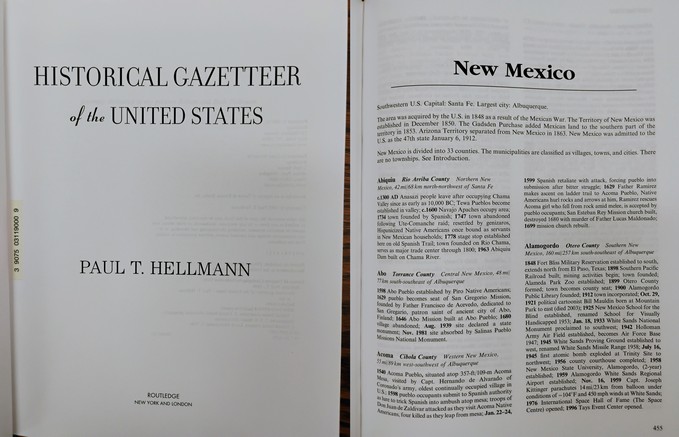
This gives a lot more information than the general gazetteer. First, you get some basic information about the state. Then, in addition to the county and the location, you get a brief historical summary of significant events and people of each place. Places are listed alphabetically by name, so you might need a road atlas to determine exactly where they are.
CIA World Fact Book
Yes, that CIA. Published annually beginning in 1977, and now entirely online, the CIA World Fact Book provides basic information on the history, people, government, economy, energy, geography, environment, communications, transportation, military, terrorism, and transnational issues for that year. It also allows you to explore individual countries as well as the oceans and regions of the world. It provides Travel Facts and Country fact sheets which can be downloaded as PDFs, flags of the world, and country comparisons.
Almanacs and Yearbooks
Issued annually, these books provide various statistic and current events for that year, including politics, sports, and entertainment. They include such titles as :
- Old Farmer’s Almanac
- World Almanac and Book of Facts
- World Book Encyclopedia Year Book
- Britannica Book of the Year/Year in Review
Your library may also collect the yearbooks of voluntary associations and organizations, such as Executive Women International of Albuquerque, Albuquerque Hispano Chamber of Commerce, Rotary Club, etc. These will include the names of the officers and the members, annual report, possibly a calendar of events.
City Directories
I mentioned these before as being my favorite resource. Now I’m going to show you why. Here are pages from the 1929 Hudspeth Directory Company’s Albuquerque City Directory.
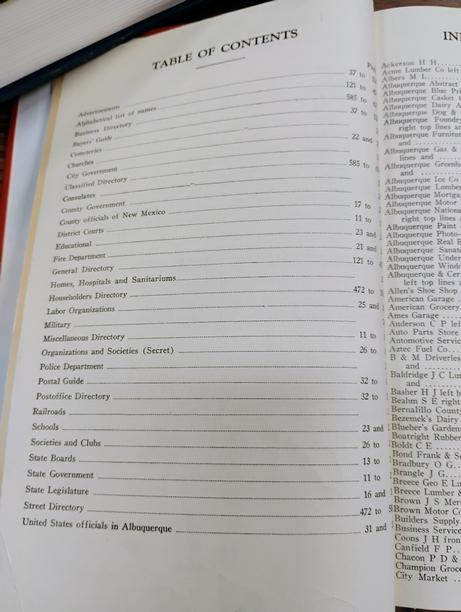
You can see from the Table of Contents the range of information provided. It’s not just for the city but the county and state and more. It provides basic information about the city for that year, and the names of government officials, including judges, chiefs of police, and other officials. It provides a lot of information and detail in just a few words. And, as any good directory does, it lists individuals and businesses alphabetically. It gives their address and, later, telephone number. However, it also tells us their profession and their spouse’s name.
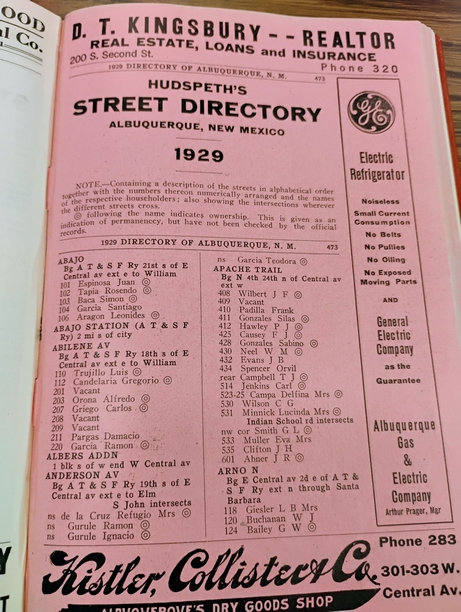
No other source has this directory of the entire city by address. Streets with names are listed alphabetically, then numbered streets in numeric order. You can see exactly what was on that block, on either side of an address, and across the street. It tells you who lived there or what kind of business occupied the premises.
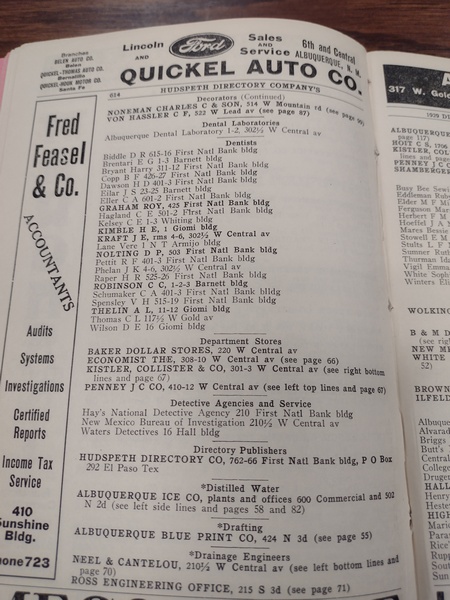
The classified directory lists businesses alphabetically by type. It not only tells us who offered what service, it tells us the kinds of services offered. You could then check the address in the street directory to see what other businesses were nearby.
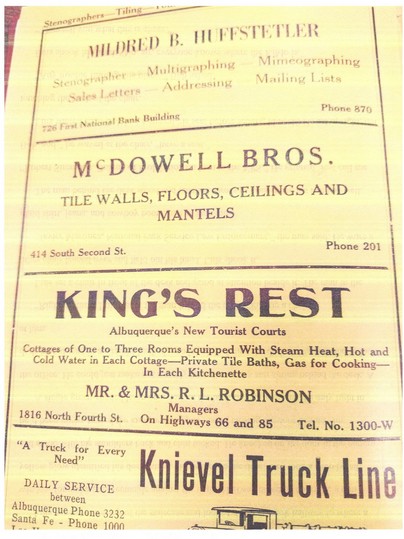
Finally, the yellow pages. These were half-page and quarter page ads. They don’t appear to be in any particular order. The page number of the ad appears after the business’s name in the classified directory. You can then look it up in the Classified Directory and the Street Directory for even more information. This ad tells us almost everything we could want to know about the King’s Rest.
Biographical Resources
These are primarily biographical dictionaries (shorter entries) and encyclopedias (longer entries). There are the usual “Who’s Who” most of you are familiar with. You can find them by profession, ethnicity, geography, and surname. The Encyclopedia of Cold War Espionage, Spies, and Secret Operations might be of interest to some of you.
They are not all nonfiction. For instance, The Women of Classical Mythology and The Zombie Book: The Encyclopedia of the Living Dead.
Newspapers
Major news stories, of course, but also the personals, the want ads, and other advertising that will tell you the movies showing and entertainment on offer, stores names, grocery prices, and other items. Some restaurants even published menus.
Your public library may provide access to searchable digitized newspapers and may also have newspapers on microform. Chronicling America from the Library of Congress is free to everyone.
Local History Collections
Ask your librarian! The library may have copies of
- High school yearbooks and student newspapers
- Family histories, biographies, memoirs, oral histories
- Ephemera: brochures, flyers, pamphlets, etc.
- Archival collections
- Scrapbooks and minutes of meetings of associations, businesses, individuals
- Photographs
- ???? – You’ll never know until you ask!
Please scroll down to leave/read comments on this post.
After 20 years as a librarian and 20 as a professor of library science and library historian, Suzanne Stauffer has moved on to a third career as a mystery novelist. She currently lives in Albuquerque with her Australian husband and brown and white spotted rat terrier dogter, Treme. Her debut novel, Fried Chicken Castañeda (Artemesia Publishing, May 2025), won the CIPA EVVY Bronze Medal in Mystery/Crime/Detection and the New Mexico Book Award for Cozy Mystery. Her second novel, French Toast à la Santa Fe, will be released on October 13, 2026. She also writes a monthly newsletter, Amuse-Bouche.


In response to comments on the listserve : Yes, all of this information can be used to create an authentic contemporary environment, as well. People and places have background and history. Your story will be richer for including it. I also imagine writing a ghost story set in a real building and using the actual names and stories of the people who lived there to create the ghost — nothing actionable, of course (LOL), but a mother who died in childbirth, a child who died from polio or some other disease, a father who was killed in a car or work accident. Paging through old newspapers can result in all kinds of inspiration.
I highly recommend getting to know your local librarians. They will know what resources your library has and provides access to.I love the fact that we can get a detailed picture of a place without having to spend time and money (we don’t have) to go there.I did a dive into the etymology of the word. Turns out it’s from the Italian “gazetta,” which actually means “newspaper” (and has its own etymology). So, a gazetteer is (was) a journalist. It was also used to mean “newspaper,” the thing that gazetteers produced, as in the London Gazette (https://www.thegazette.co.uk/). According to etymonline (https://www.etymonline.com/word/gazetteer ) “Meaning “geographical dictionary” is from 1704, from Laurence Eachard’s 1693 geographical handbook for journalists, “The Gazetteer’s, or Newsman’s, Interpreter,” second edition simply titled “The Gazetteer.””
LikeLike